
AI sprawl is the uncontrolled growth of AI tools, agents, and accounts across a company, spreading faster than IT can track or govern them.
Gartner projects the average Fortune 500 company will run over 150,000 AI agents by 2028, yet only 13% of organizations say they're ready to govern that scale.
I've spent this piece mapping what IBM, Gartner, and Forbes are each finding on this problem, so here's what AI sprawl is, what's driving it, what it costs, and how to bring it under control.
What is AI sprawl? The 30-second answer
AI sprawl is what happens when AI tools, models, and agents spread across departments faster than any central team can inventory, secure, or govern them, usually because adoption moved faster than oversight did.
Bottom line: It's not any single bad decision. It's the accumulated effect of dozens of small, reasonable-seeming ones made without anyone seeing the whole picture.
Key traits of AI sprawl
A few traits show up consistently in how IBM defines this problem.
- Fragmentation: Different teams build or buy AI tools independently, with no shared visibility across the organization.
- No central inventory: IBM's own research found only 18% of organizations keep a current, complete list of the AI agents they're running.
- Redundancy: Salesforce's 2026 Connectivity Benchmark found the average company runs 12 agents, with half operating in silos instead of as part of a coordinated system.
- Governance lag: Oversight, ownership, and retirement processes consistently trail adoption instead of leading it.
AI sprawl vs. AI agent sprawl vs. shadow AI: what's the difference?
These three terms get used almost interchangeably, but they describe different parts of the same problem, and mixing them up leads to the wrong fix.
Here's how the three terms break down:
IBM draws this exact line. Shadow AI is about unauthorized tools, while agent sprawl is a structural problem that can happen even with fully sanctioned, IT-approved agents deployed without coordination.
AI sprawl is the umbrella term covering both. Our shadow AI guide covers that specific piece in depth, so this page won't re-explain it.
What causes AI sprawl?
AI sprawl has two distinct causes, and most coverage addresses only the first.
The visible half is unsanctioned tools. Employees sign up for AI products on their own, outside any approval process, and that's shadow AI.
The less visible half is sanctioned vendors switching AI features on by default inside tools your company already pays for and approved months or years ago.
A CRM, a helpdesk platform, or a document tool can ship a new AI feature turned on automatically, and it never passes through whatever review process new software normally would, because nobody re-reviews software they already approved.
That second half matters because shadow AI detection tools are built to catch the first cause and structurally blind to the second. A feature that arrived through an existing, approved vendor doesn't look like a new, unauthorized tool to anything scanning for one.
Types of AI sprawl
AI sprawl doesn't look the same everywhere it shows up. Breaking it into categories makes it easier to spot in your own organization.
Here's how the four patterns break down:
Real-world examples of AI sprawl
These patterns show up in recognizable ways across most companies running into this problem.
A few examples:
- A marketing team's AI copy tool starts touching customer data. What began as a blog-drafting assistant gets connected to the CRM for personalization, and customer records start flowing through a vendor nobody on the security team reviewed.
- Three departments buy the same category of tool within a year. Sales, support, and operations each adopt their own AI chatbot platform independently, paying three separate subscriptions for work one tool could have covered.
- An AI coding assistant keeps its repository access long after the project ends. The access was approved for one engagement, nobody revoked it when that engagement wrapped, and no one owns the job of shutting it down.
What AI sprawl actually costs
Pros (what's working despite the risk)
Fast AI adoption is still delivering real value where it's contained. Teams experimenting freely find genuine wins faster than a slow, centrally-gated rollout ever would, and that speed is worth preserving even while fixing the sprawl it creates.
Cons (the three costs that compound)
Expanded attack surface: Every new AI tool or agent brings its own integrations, API keys, and OAuth tokens, and unmonitored ones are exactly the gap attackers look for. More connections nobody's tracking means more paths in.
Proprietary data entering unvetted models: Employees paste business data into tools nobody reviewed for what happens to that data afterward, where it's stored, or whether it trains someone else's model.
Duplicated spend: When five departments each adopt a similar AI tool independently, the company pays five times for overlapping capability it could have bought once.
Should your organization worry about this now? My take
If you can't currently produce a complete list of every AI tool and agent running in your company, the answer is yes. The Gartner and IBM data above suggest most organizations are in the same position.
This is urgent if you:
- Have multiple departments independently adopting AI tools with no shared visibility.
- Can't say with confidence which SaaS vendors have turned on AI features by default.
- Have no current, complete inventory of AI agents and tools in production.
You can move more gradually if you:
- Operate a small, single-team AI footprint with one clear owner.
- Already run AI tool discovery as an ongoing practice.
How to bring AI sprawl under control in 5 steps
This process works best as a sequence that builds visibility before adding restriction.
Here's the sequence:
1. Build a central registry: Catalog every AI tool, model, and agent in use, including who owns it, what data it touches, and why it exists. Our shadow AI detection tools guide covers finding what isn't on your radar yet.
2. Apply least-privilege to every non-human identity: Treat each AI agent and integration as its own account, with scoped permissions rather than a standing, broad grant. Okta's own AI agent security work frames this as the core fix for credential sprawl.
3. Re-review sanctioned vendors on a recurring schedule, long after they're first approved: Check which already-approved tools have switched on AI features since you last reviewed them.
4. Give teams one approved platform that can keep up: Restriction alone pushes people toward shadow AI. A sanctioned platform fast enough to meet real demand is what makes the registry stick.
5. Make this a standing process: New tools and features enter the picture constantly, so discovery has to run on an ongoing basis.
Pro tip: Start the registry with your highest-risk integrations, the ones touching customer or financial data, ahead of trying to catalog everything in one pass.
AI sprawl best practices
A few habits separate organizations that close this gap from those that let it widen unnoticed.
Here's what separates them:
- Assign an owner to every agent and tool, across the whole organization: A tool with no named owner is the one nobody notices going dormant or out of scope.
- Build governance in at the moment of creation: Our AI code guardrails guide covers enforcing standards at the point something gets built.
- Measure how much AI tools duplicate each other's work: Twelve AI tools doing six jobs is a different problem than twelve tools doing twelve jobs, and counting tools alone misses that.
My verdict on AI sprawl
Every source points to the same pattern. Adoption is outrunning governance everywhere, regardless of company size or maturity.
Gartner's own 150,000-agent prediction and the finding that only 13% feel ready for it is as much a statement about this current moment as about any specific organization.
The sanctioned-vendor half of this problem is the one that gets missed most, since it's invisible to anything built to catch shadow AI specifically.
Forbes has covered how directly this hits smaller companies already, where a handful of overlapping subscriptions adds up fast relative to the budget available.
Where Superblocks fits
Most AI sprawl control starts by discovering and cataloging tools after they've already spread. Superblocks takes a different angle on one major source of that sprawl: the internal apps and workflows business teams build directly with AI.
Every app built on Superblocks comes governed from creation, with RBAC and a central registry built in from the start, providing a central view of every app built on the platform, its permissions, and its audit trail. Audit logs are available on Enterprise plans.
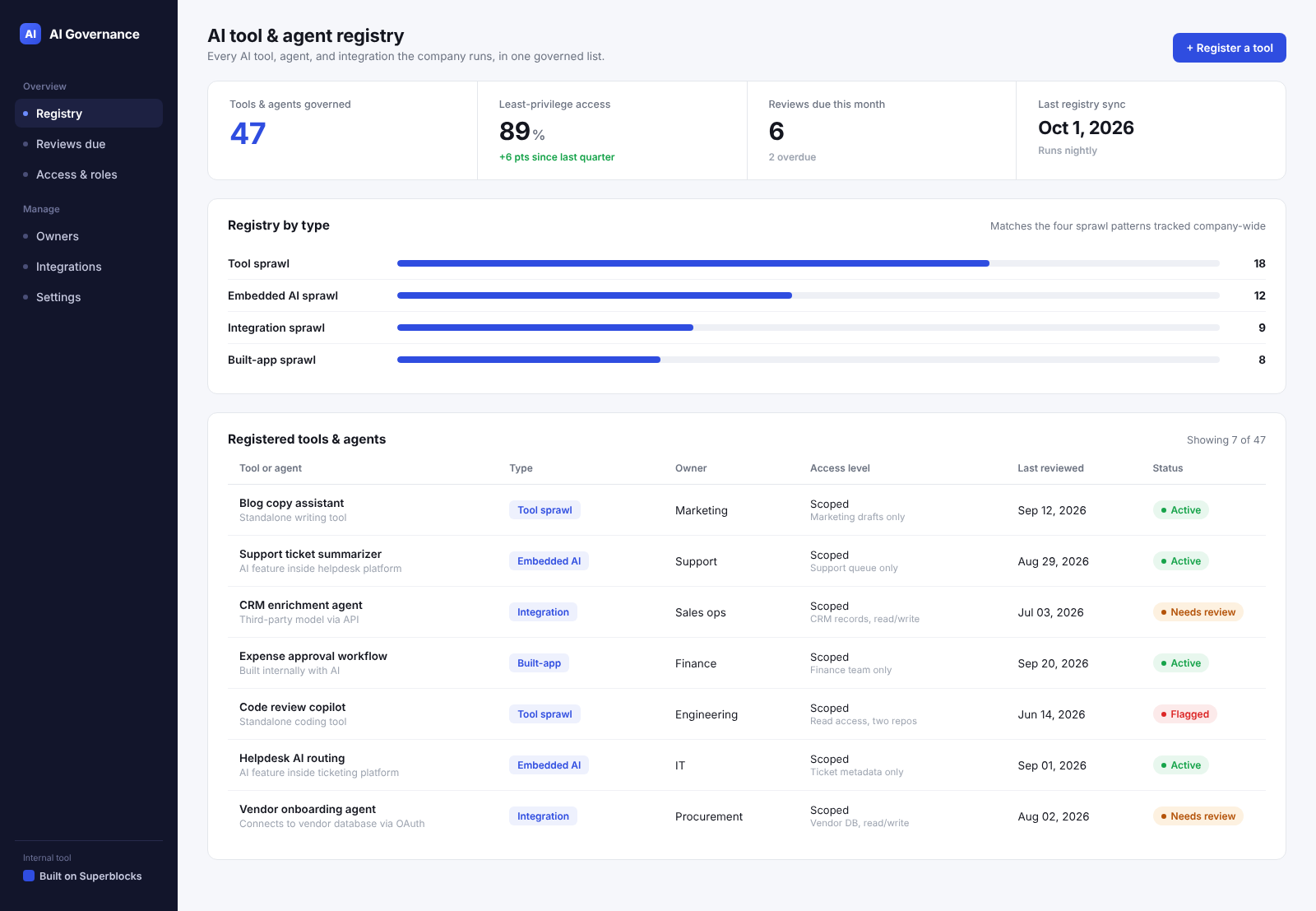
For the AI-built-app side of this problem specifically, our piece on how enterprises are governing the AI app flood covers that in more depth, and our broader AI governance guide covers the principles this all sits under.
See how to bring your next internal AI app under the same kind of registry and RBAC control shown above, with the Superblocks Quickstart Guide.
Or book a demo to see how Superblocks fits into your own plan for bringing AI sprawl under control.
Frequently asked questions
What is AI sprawl?
AI sprawl is the uncontrolled spread of AI tools, models, and agents across an organization, growing faster than any central team can inventory or govern. It includes both unsanctioned tools employees adopt on their own and sanctioned vendors switching on AI features by default.
What is the difference between AI sprawl and shadow AI?
The difference between AI sprawl and shadow AI comes down to scope. AI sprawl is the broader, ungoverned spread of AI tools and agents across an organization, while shadow AI means only the unauthorized tools employees adopt on their own. Shadow AI is one cause of AI sprawl.
What causes AI sprawl?
AI sprawl has two main causes. Employees adopt unsanctioned AI tools on their own, and approved vendors enable AI features in tools a company already uses without flagging the change. The second cause is harder to catch, since it never passes through a new-software review process.
How much does AI sprawl actually cost a company?
AI sprawl costs companies through three compounding factors. An expanded attack surface comes from unmonitored integrations, proprietary data enters AI models nobody vetted, and duplicated spend piles up when multiple teams buy overlapping tools independently. Forbes has documented one small marketing firm spending over $1,000 a month on redundant AI writing tools alone.
What tool helps control AI sprawl from internally built apps?
Superblocks helps control AI sprawl from internally built apps by applying RBAC and a central registry automatically from the moment something is built, with audit logs available on Enterprise plans. Dedicated AI discovery platforms remain the right tool for cataloging sprawl across purchased SaaS tools and third-party models.
At Virgin Voyages, non-technical teams now build their own AI apps, with IT governance fully intact. The result: 15+ production apps, seven departments onboard, and zero dedicated frontend engineers.
At Matthews, a marketing manager with zero coding background built an app that auto-generates offering memorandums, cutting turnaround from days to hours. See how the brokerage is putting AI builders on every team, with full governance intact.


Stay tuned for updates
Get the latest Superblocks news and internal tooling market insights.
Request early access
Step 1 of 2
Request early access
Step 2 of 2

You’ve been added to the waitlist!
Book a demo to skip the waitlist
Thank you for your interest!
A member of our team will be in touch soon to schedule a demo.
production apps built
days to build them
semi-technical builders
traditional developers
high-impact solutions shipped
training to get builders productive
SQL experience required
See the full Virgin Voyages customer story, including the apps they built and how their teams use them.

"Those tools are great for proof of concept. But they don't connect well to existing enterprise data sources, and they don't have the governance guardrails that IT requires for production use."
Table of Contents
%20(1).png)

Multiple authors
11 Best AI Agent Deployment Platforms for Governed Production in 2026
An AI agent deployment platform has to keep state, trace every step, and stay governed. I compared 11 on runtime limits, tracing, and IT controls.
%20(1).png)
%20(1).png)